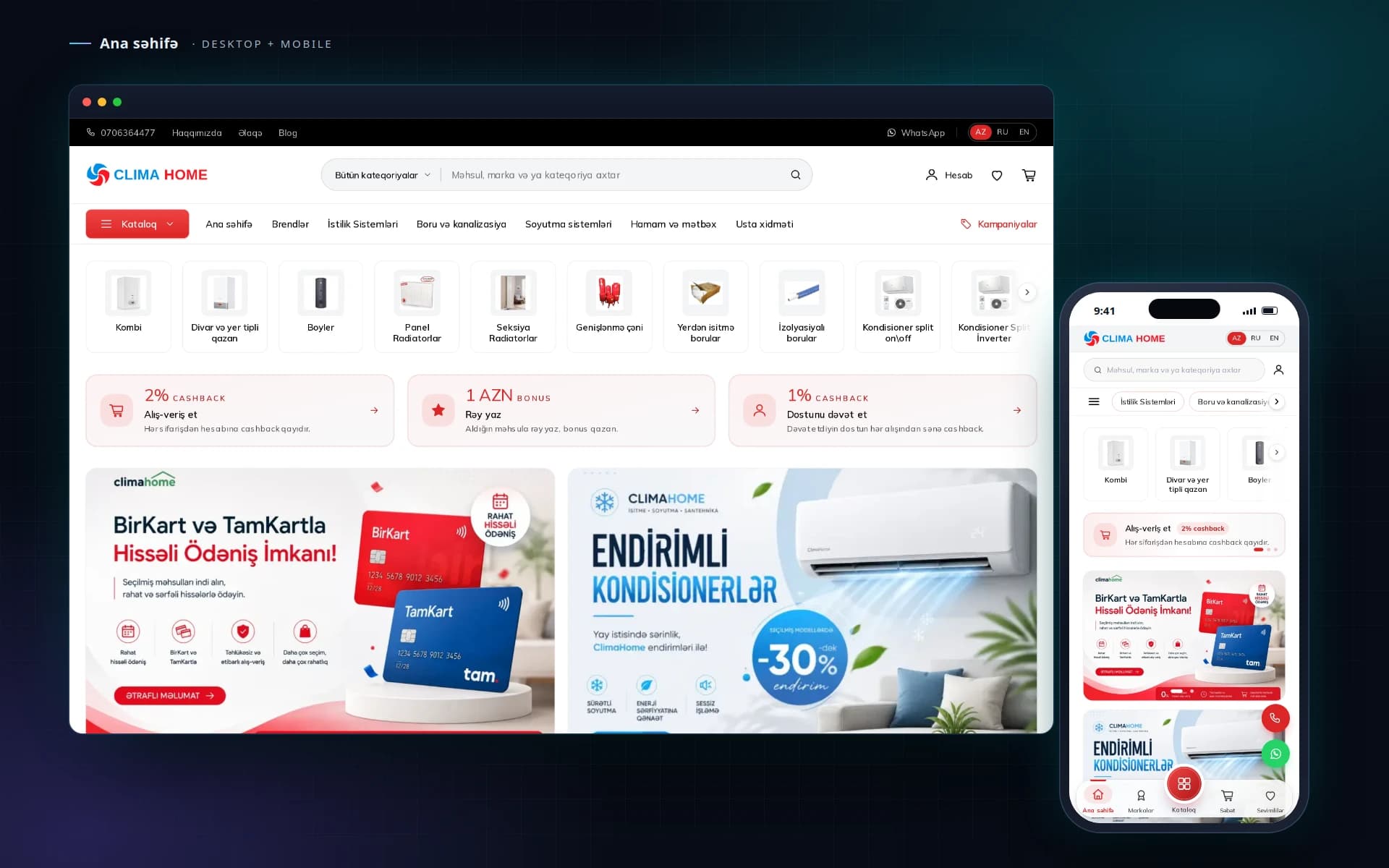
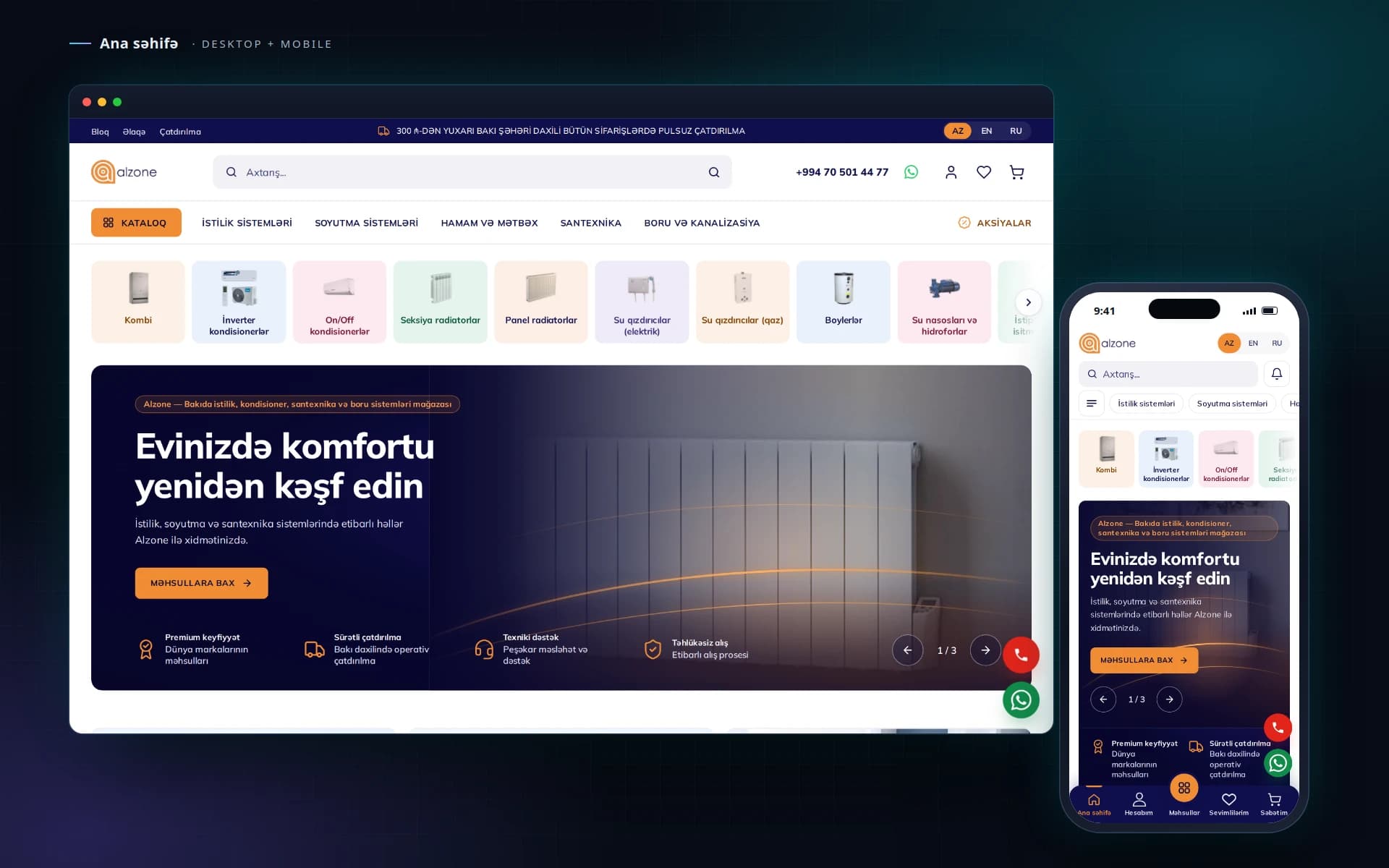
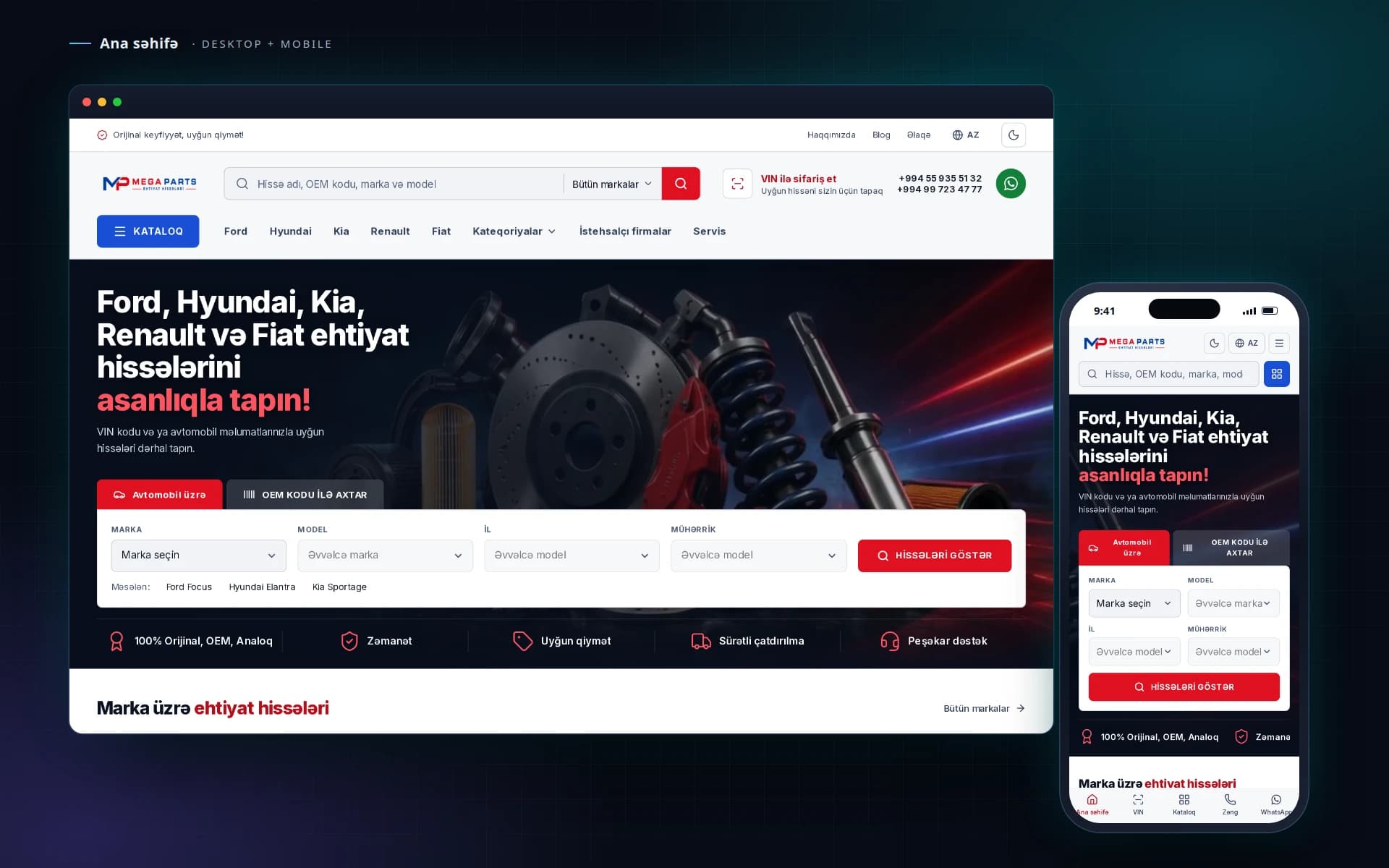
H2 Solutions builds ecommerce projects from scratch: retail online stores, B2B sales platforms for wholesale buyers, marketplaces where several sellers trade, and custom ecommerce for non-standard sales models. Three of our stores are live in Azerbaijan. Climahome sells heating and cooling systems, Alzone is a plumbing and heating store with more than 1,800 products, and MegaParts sells car parts.
When does a store of your own make sense?
Most clients come to us at a turning point. They are taking a physical shop online, or moving from Instagram and classifieds sites to a store of their own. Some want wholesale orders out of phone calls and WhatsApp and into a system, and others are replacing an old, slow store. A buyer who cannot find the right product quickly leaves. So categories, filters and search sit at the center of the project, and an order is completed in a few steps.
From first brief to first sale
First we study your sales process: how a product is chosen, how the price is formed, how delivery and payment work. The store opens with its core functions, and further features arrive in stages, so you start selling sooner. We prepare every product and category page individually to be found on Google. The price is fixed in a written quote. The store and all its data belong to you, and there is no monthly platform fee.
Last updated:
What's included?
- Online store development — catalog, filters, search, cart and checkout
- B2B ecommerce platform — wholesale prices, customer-specific terms, repeat orders
- Marketplace development — multiple sellers, seller accounts and commission calculation
- Custom ecommerce — product configurator, compatibility-based selection, non-standard pricing
- Payment options — online payment, payment on delivery and payment in installments
- Admin panel — manage products, prices, stock, orders and discounts
- Bulk import — products loaded from an Excel file or your accounting system
- Search and analytics — product pages optimized for Google, plus sales analytics
Questions about this service
It depends on the size of the catalog and its filter logic, payment and delivery integrations, data exchange with an accounting or inventory system, the number of languages and how custom the design is. We prepare a written quote with a fixed price from the feature list. There is no monthly platform fee.
That depends on the number of products, the complexity of the filters, payment and delivery integrations and the number of languages. After the brief we give you a staged schedule. The store usually opens with its core functions first, and extra features follow in later stages.
Online payment by bank card, cash or card payment on delivery, and installment options can all be connected. For online payment you sign the contract with the bank or payment provider you choose, in your company's name. We do the technical integration.
Not one by one. We set up bulk import from an Excel file or your existing accounting system, and images and attributes come in the same way. We have done this for large catalogs such as Alzone, which has more than 1,800 products.
A ready-made platform is good for a fast, cheap start. With a large catalog, though, speed, non-standard filters and local payment and accounting integrations end up depending on plugins. In a custom store the functions are written around your sales process, and the store belongs to you. If a ready-made platform is the better value for a small catalog, we tell you.
Next.js for the storefront the buyer sees, and Laravel for the admin panel where products and orders are managed. Product structured data is added to every product page. When you move from an old store, we prepare 301 redirects for all old URLs so that visibility on Google is not lost. Short-term fluctuation is still possible.
Yes, if the software has an API or can export data. Prices, stock levels and orders then move automatically between the store and your accounting system. Where there is no API, we set up an exchange through Excel or CSV files. We check your software and state the right approach in the proposal.
Every category and product page is prepared for Google on its own: its own title, description, Product structured data and a fast-loading page. The sitemap updates automatically, so a new product is added to it as soon as you publish it. If you want ongoing SEO, it continues as monthly work with a report.