

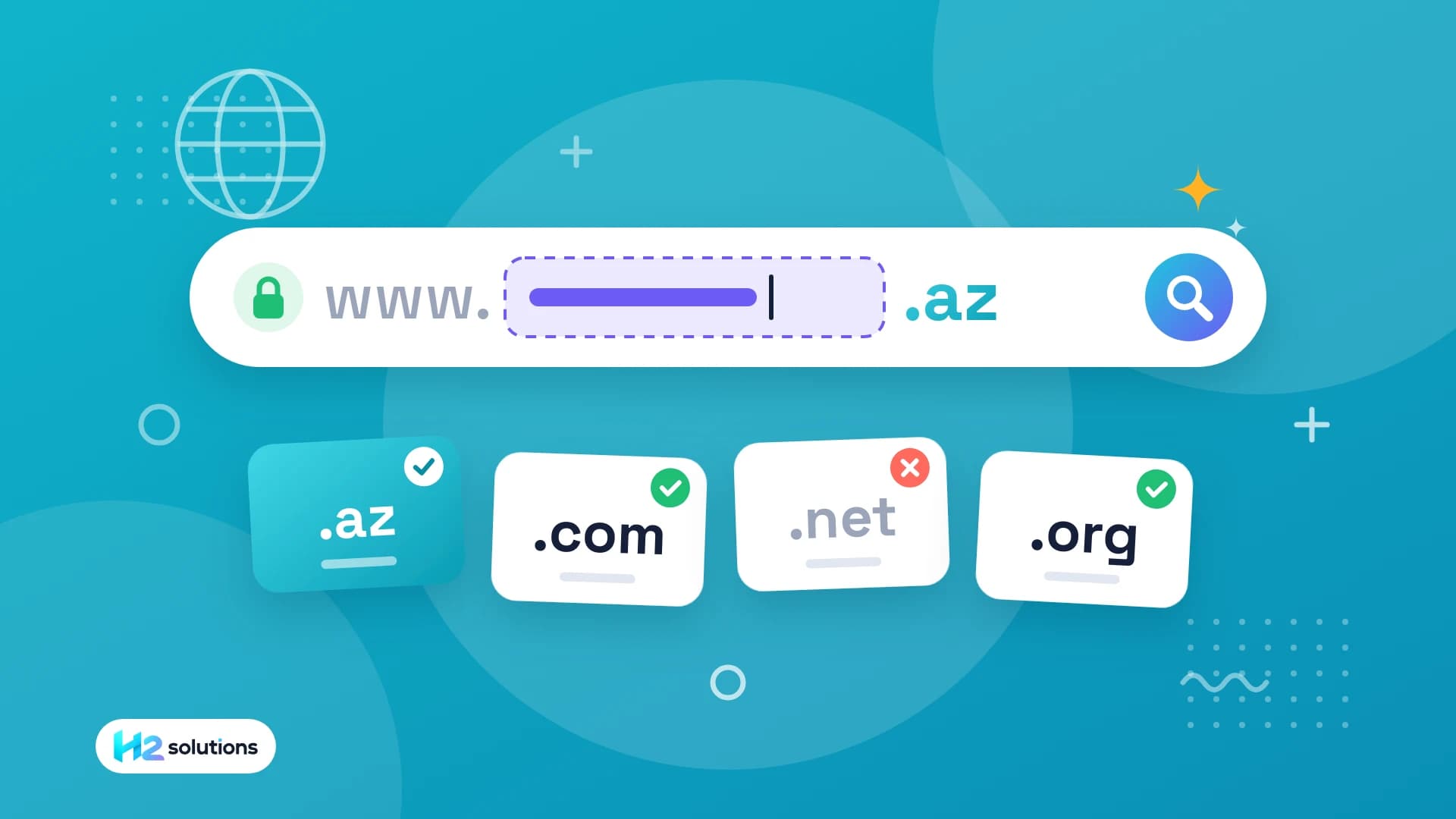
Short answer: .com is still the safest choice for most businesses that sell online or to more than one country: it is open to anyone, recognised everywhere and not tied to any country. If almost all your customers are in one country, that country's domain can work better locally. Many businesses register both and point one to the other. Before you buy, check that the name is available, easy to spell, matches your brand and does not use someone else's trademark.
What is a domain name and why does it matter?
A domain name is your website's address, such as yourcompany.com. It is often the first thing a customer sees: on ads, business cards, social profiles and in your email address (hello@yourcompany.com). That makes it part of your brand, not just a technical setting.
The ending (.com, .net, .de) is the top-level domain (TLD). There are two main types:
- Generic TLDs: .com, .net, .org and others. Not tied to a country.
- Country-code TLDs: .uk, .de, .az and others. Tied to a specific country.
Is .com still the best domain for business?
| Criterion | .com | Country domain (e.g. .uk, .de) |
|---|---|---|
| Best for | International businesses, online services, brands planning to grow abroad | Businesses whose customers are mainly in one country |
| Search signal | Not tied to any country | Clearly signals that the site targets that country |
| Customer perception | Familiar and global | Local and trusted by that country's users |
| Who can register | Anyone, worldwide | Depends on the country's rules |
| Available names | Most short, simple names are taken | Short names are usually easier to find |
According to Google's guide to multi-regional sites, a country-code domain is a strong signal to users and search engines that a site is meant for a specific country, while a generic domain like .com is not tied to one. So .com suits a site that serves several countries, and a country domain suits a site that serves one. Neither replaces good content, speed and technical health.
How do .com domains work?
.com is the largest top-level domain in the world. The registry that runs it is Verisign, and you buy a .com through a domain registrar accredited by ICANN, the organisation that coordinates domain names worldwide.
- Open to everyone. There is no residency or company requirement: individuals and businesses from any country can register a .com.
- Registration period. Domains are registered for a set term (usually 1 year or more) and must be renewed before they expire.
- Accurate contact details. Registrars ask for the registrant's name and contact data. Give correct details in your company's name: this is what proves you own the domain.
.com vs .net and other alternatives
If your .com is taken, you will see offers for .net, .co, .io and many newer endings. A few rules of thumb:
- .net was meant for network and internet services. It works, but customers often type .com by habit, so traffic can go to whoever owns the .com.
- .co and .io are country domains (Colombia and the British Indian Ocean Territory) that became popular with startups. They are fine for tech brands but less familiar to general audiences.
- Adding a word is often better than changing the ending: getyourbrand.com or yourbrandstudio.com keeps the familiar .com.
How to choose a good domain name
- Keep it short. Long addresses are hard to remember and easy to mistype.
- Make it easy to spell. If you say it out loud, people should know how to write it.
- Match your brand. Your company name is the best domain. If it is taken, add a short, natural word.
- Avoid hyphens and numbers. They are hard to say over the phone and cause mistakes.
- Check trademarks. A name that uses someone else's brand can be disputed and taken away.
- Think long term. Tie the name to your brand, not to one product or city, so it still fits as you grow.
How to check a domain before you buy it
- Check availability. Use any registrar's domain search or a WHOIS lookup. If the name is taken, WHOIS usually shows when the registration expires.
- Check its history. A previously used domain may have been linked to spam. Search site:domain.com on Google and look it up in web archives.
- Check social handles. If the same name is free on social networks, your brand will look consistent everywhere.
- Register it in the right name. The domain should belong to your company or its owner, not to a designer or a former employee.
What to do after you register your domain
- Turn on auto-renewal. An expired domain stops your website and email from working and can eventually be registered by someone else.
- Set up business email. hello@yourcompany.com looks more trustworthy than a free email address.
- Redirect extra domains. If you own several endings, choose one main domain and 301-redirect the others to it. The same site on two addresses is bad for SEO.
- Install an SSL certificate. Your site should open with https://, or browsers will warn visitors.
- Add the site to Google Search Console. It shows how your site appears in search. If your site does not show up on Google, see Why isn't my website showing on Google?
Next step
A domain is only the first step. We explain how a website is built in How to create a website and what affects the price in How much does a website cost? If you want help choosing a domain and building your site, see our web development service or contact us: we reply within 24 hours and offer a free 30-minute online consultation. You can see our work on our home page.
Frequently asked questions
Is .com better than a country domain?
For international or online-only businesses, usually yes, because .com is global and familiar. For a business that serves one country, that country's domain sends a clearer local signal to users and search engines.
Can anyone register a .com domain?
Yes. There are no residency or company requirements. Individuals and businesses from any country can register a .com through an ICANN-accredited registrar.
Does a .com domain help SEO?
Not by itself. Google treats .com as a generic domain that is not tied to a country. Rankings depend mainly on content, speed and technical health, not on the ending.
What if the .com I want is taken?
Check when it expires with WHOIS, consider adding a short word to your name, or use your country domain. Avoid names that are very similar to another company's brand.
Should I buy several domain endings?
It is a good way to protect your brand. Use one as the main domain and redirect the others to it.
What happens if my domain expires?
Your website and email stop working, and after a grace period the domain can be registered by someone else. Turn on auto-renewal and keep your registrar contact email up to date.
Conclusion
.com remains the most universal choice: open to anyone, recognised worldwide and suited to businesses that serve more than one country. If your customers are in one country, its domain can be a strong local alternative, and owning both is the safest option. Keep the name short, easy to spell and on-brand, register it in your company's name and turn on auto-renewal. If you have questions about your domain or website, get in touch.
Last checked: 10 November 2026.